Strategy
Basic Strategy Chart — Blackjack
The optimal decision for every situation. Match your hand against the dealer's upcard.
Columns → dealer's upcard Rows ↓ your hand
| Your hand ↓ | 2 | 3 | 4 | 5 | 6 | 7 | 8 | 9 | 10 | A |
|---|---|---|---|---|---|---|---|---|---|---|
| Hard hands | ||||||||||
| 17+ | S | S | S | S | S | S | S | S | S | S |
| 16 | S | S | S | S | S | H | H | H | H | H |
| 15 | S | S | S | S | S | H | H | H | H | H |
| 14 | S | S | S | S | S | H | H | H | H | H |
| 13 | S | S | S | S | S | H | H | H | H | H |
| 12 | H | H | S | S | S | H | H | H | H | H |
| 11 | D | D | D | D | D | D | D | D | D | H |
| 10 | D | D | D | D | D | D | D | D | H | H |
| 9 | H | D | D | D | H | H | H | H | H | H |
| 5 to 8 | H | H | H | H | H | H | H | H | H | H |
| Soft hands (with an Ace) | ||||||||||
| A-8 → A-10 | S | S | S | S | S | S | S | S | S | S |
| A-7 | S | D | D | D | D | S | S | H | H | H |
| A-6 | H | D | D | D | D | H | H | H | H | H |
| A-5 | H | H | D | D | D | H | H | H | H | H |
| A-4 | H | H | D | D | D | H | H | H | H | H |
| A-3 | H | H | H | D | D | H | H | H | H | H |
| A-2 | H | H | H | D | D | H | H | H | H | H |
| Pairs | ||||||||||
| A-A / 8-8 | SP | SP | SP | SP | SP | SP | SP | SP | SP | SP |
| 10-10 | S | S | S | S | S | S | S | S | S | S |
| 9-9 | SP | SP | SP | SP | SP | S | SP | SP | S | S |
| 7-7 | SP | SP | SP | SP | SP | SP | H | H | H | H |
| 6-6 | SP | SP | SP | SP | H | H | H | H | H | H |
| 5-5 | D | D | D | D | D | D | D | D | H | H |
| 4-4 | H | H | H | SP | SP | H | H | H | H | H |
| 3-3 | SP | SP | SP | SP | SP | SP | H | H | H | H |
| 2-2 | SP | SP | SP | SP | SP | SP | H | H | H | H |
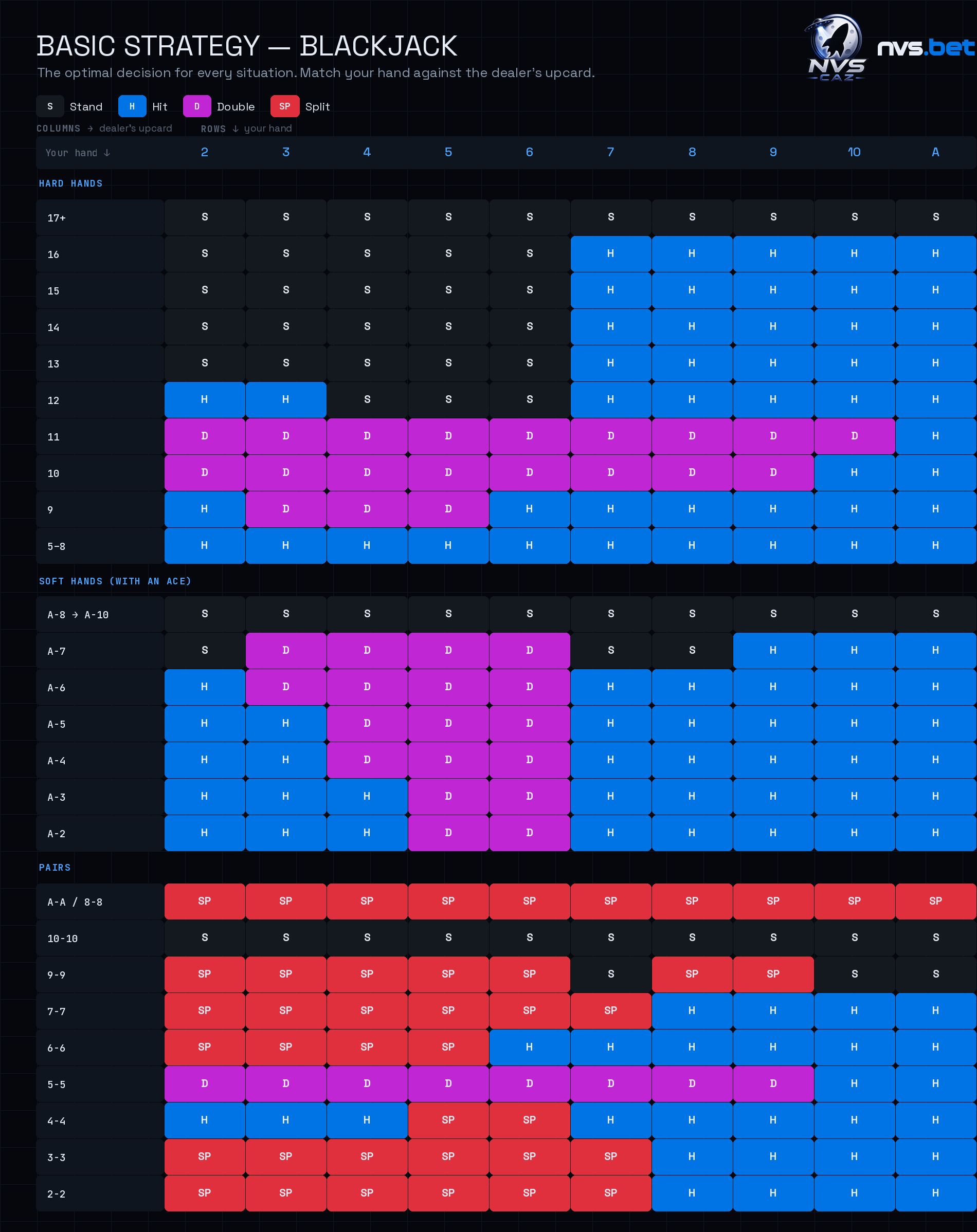
Chart based on the most common rules (dealer stands on soft 17, double after split allowed). Check your table's rules: they change a few cells slightly. Basic strategy lowers the house edge. It doesn't remove it.
How to read the chart
Three seconds per decision, once it becomes a reflex.
Find your hand, on the left
Add up your cards. If you have an Ace that can count as 11 without taking you over 21, you're holding a soft hand, so head to the second section of the chart.
Look at the dealer, at the top
Only one of their cards is face up, and it's the only one that matters. The whole decision hinges on it.
Cross-reference, and play the cell
The colour where they meet gives you the move. No gut feeling, no exceptions: it's that, or the chart loses its point.
Why these decisions
Understanding the logic is what stops you from deviating at the wrong moment.
It all starts with one unfair rule: you play before the dealer. If you both bust, you've already lost. That's exactly where the house edge lives, and the whole chart is about limiting the damage from that rule.
Hence the two-block logic. When the dealer shows a 4, 5 or 6, they're in trouble: they'll have to draw, and they bust often. No point taking risks: you stand from 12 and let them crash on their own.
When they show a 7 or higher, it flips: they'll usually end up between 17 and 21. Standing on 15 against a 9 means hoping for a miracle. You have to build your hand, even if hitting on 16 hurts.
The rest are the moments when you have the edge. Doubling on 11 or 10, splitting 8s: that's putting more money on the table exactly when the situation favours you. Those spots are rare, and missing them costs more than you'd think.
The most costly mistakes
Six habits that feel logical and chip away at you, hand after hand.
Taking insurance
It's a separate bet on the dealer having blackjack, and it loses over time. Turn it down every time: the name sounds reassuring, the maths much less so.
Standing on 16 against a 7
Hitting on 16 is unpleasant, but standing means betting that the dealer busts. Against a 7 or higher, they don't bust often enough for that to hold up.
Splitting 10s
20 is already a hand that wins almost every time. Cutting it in two means trading one strong hand for two average ones.
Never daring to double
Lots of players never touch it, scared of putting more on the table. Yet it's the only moment you can bet more while you're ahead: skipping it means letting a good chunk of what the strategy earns slip away.
Copying the dealer
Always standing on 17 seems logical since that's their rule. Except they play last: the same rule gives a completely different result.
Playing on "gut feeling"
The chart doesn't change because you've lost three in a row. Every hand starts from scratch, and that's exactly what your brain refuses to accept.
FAQ
Does this chart let you win?
No, and it's worth being clear about that. Basic strategy brings the house edge down from around 2% to around 0.5% under common rules. The expected value is still negative: over time, the casino wins. The chart makes you lose more slowly, it doesn't flip anything.
Do I need to learn it by heart?
Online, no: keep the PNG open next to you, nobody's timing you. If you still want to memorise it, start with the rows you'll run into most often: hands from 12 to 16 and pairs. The rest comes naturally.
Does it work at every table?
This chart is based on the most widespread rules: multiple decks, dealer stands on soft 17, double after split allowed. If your table says the dealer hits soft 17, a few cells change. The rules are always posted before you sit down.
Why split 8s against a 10?
Because 16 is the worst hand in the game. Splitting doesn't make the situation good (it's still a losing spot), but two hands starting on 8 lose less money than a 16 played as is. It's damage control, not a winning move.